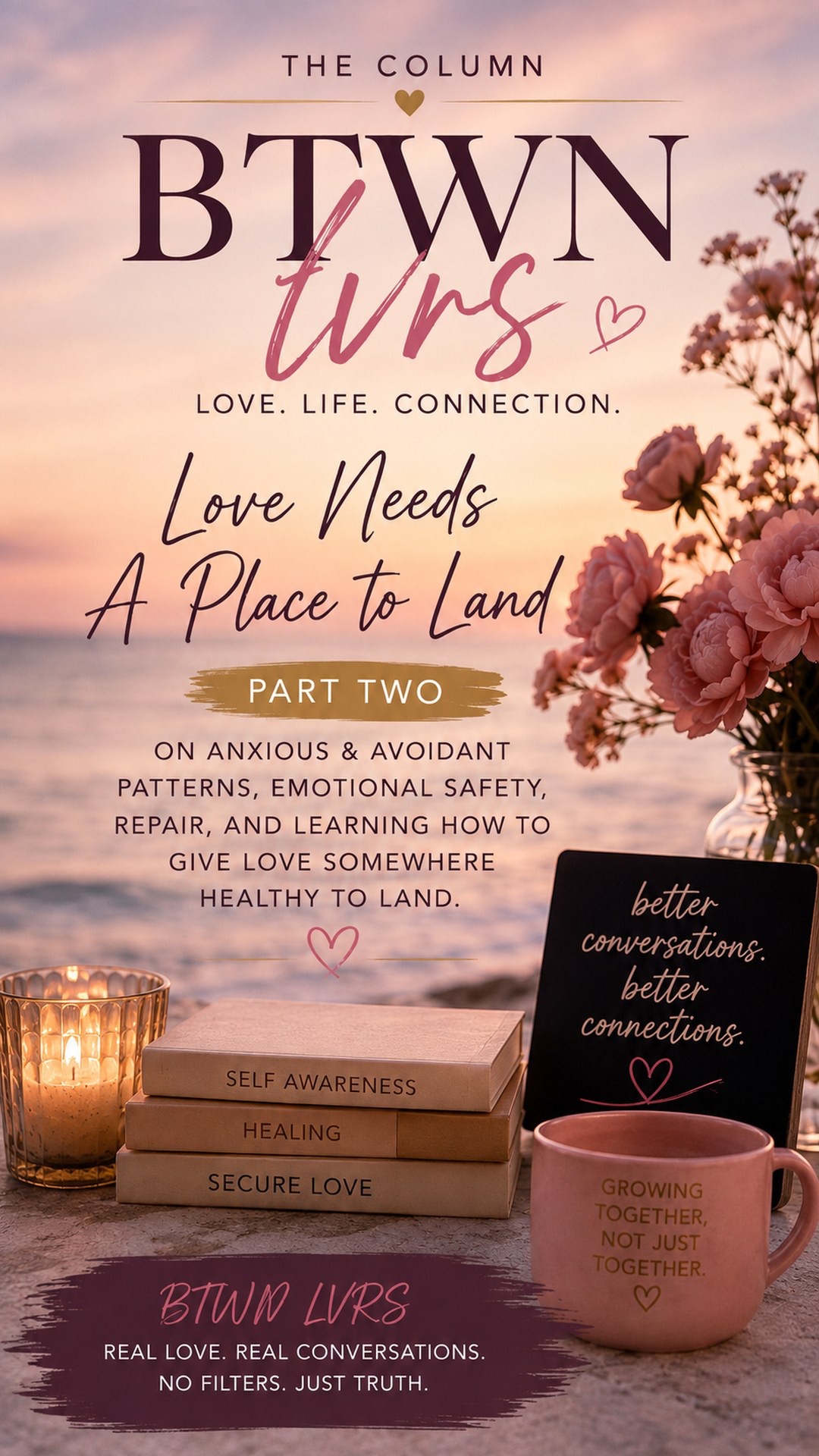
On anxious patterns, avoidant patterns, and learning how to make love safer to receive.
One of the most exhausting relational dances happens when one person reaches for closeness and the other reaches for distance.
One says, “Can we talk?”
The other says, “Why does everything have to be so deep?”
One feels abandoned.
The other feels cornered.
One sends three paragraphs.
The other sends, “K.”
Now everyone is fighting demons.
The anxious person may think, “If they loved me, they would reassure me.”
The avoidant person may think, “If they loved me, they would give me space.”
Both may be telling the truth from inside their own nervous system.
The problem is that neither truth can become the whole relationship.
Closeness without breathing room can feel like pressure.
Space without reassurance can feel like rejection.
Healthy love has to learn a rhythm.
Come close.
Be honest.
Take space.
Return.
Repair.
Repeat.
The magic is not in never needing reassurance.
The magic is in learning how to ask for it without abandoning yourself.
The growth is not in never needing space.
The growth is in learning how to take space without making the other person feel emotionally discarded.
Love needs both tenderness and structure.
Softness and accountability.
Feeling and follow-through.
Desire and capacity.
Otherwise, people end up performing love while their nervous systems are still running survival software from a much older chapter.
Availability Requires Honesty
A lot of people say they want emotionally available partners.
That is beautiful.
But emotional availability is not only something we receive.
It is something we practice.
We have to ask ourselves:
Am I emotionally available?
Can I be honest about what I feel without making the other person responsible for regulating all of it?
Can I listen when someone tells me I hurt them?
Can I name my needs without shaming myself for having them?
Can I respect someone’s boundaries without treating them as rejection?
Can I stop chasing people who cannot meet me?
Can I stop retreating from people who can?
Can I tell the difference between peace and boredom?
Can I tell the difference between chemistry and anxiety?
Can I tell the difference between healthy space and emotional absence?
That kind of honesty can change a life.
It can also change the kind of love we choose.
Because once you begin healing your attachment patterns, certain relationships stop feeling romantic and start feeling familiar in a way your wiser self no longer wants to repeat.
The unavailable person may still be attractive.
The chaotic person may still be exciting.
The emotionally confusing person may still know exactly how to get your attention.
But your attention is not the same as your devotion.
Your longing is not a contract.
Your chemistry is not a calling.
And your nervous system does not need to keep mistaking activation for love.
Love Needs Somewhere Healthy to Land
Love cannot fully land where emotional safety does not exist.
It may visit.
It may try.
It may knock.
It may linger longer than it should.
But love needs somewhere healthy to land.
It needs a place where honesty is not punished.
Where repair is possible.
Where needs are not mocked.
Where boundaries are not treated like betrayal.
Where tenderness is not used as a weapon.
Where people can be human without being constantly put on trial.
That is what many people are really looking for.
Not perfection.
Not fantasy.
Not a person who never gets triggered, never needs reassurance, never needs space, never makes mistakes, and never has an inconvenient feeling.
We are looking for a love with enough emotional maturity to hold humanity.
A love where two people can say:
I am learning.
I am scared.
I need a minute.
I hear you.
I am sorry.
I want to understand.
I do not want to keep doing this the old way.
Let us try again.
That is availability.
Not perfection.
Presence.
Willingness.
Return.
The ability to stay connected to yourself while making room for someone else.
The BTWN LVRS Truth
Attachment explains, but it does not excuse.
Emotional unavailability may have a history, but it still has an impact.
And love, real love, does not ask us to pretend our patterns are not there.
It invites us to stop letting those patterns run the whole relationship.
You do not have to shame yourself for how you learned to survive.
But you also do not have to build a home inside survival.
You can learn a new rhythm.
You can become more secure.
You can tell the truth sooner.
You can stop chasing what keeps leaving.
You can stop running from what feels safe.
You can choose the person who is willing to grow, not merely the person who knows how to stir your nervous system.
And you can become someone who gives love a healthier place to land.
Because love may be natural.
But being relational is learned.
With love, clarity, and a little nervous system honesty,
Tee
Your Love Guide
Leave a Reply