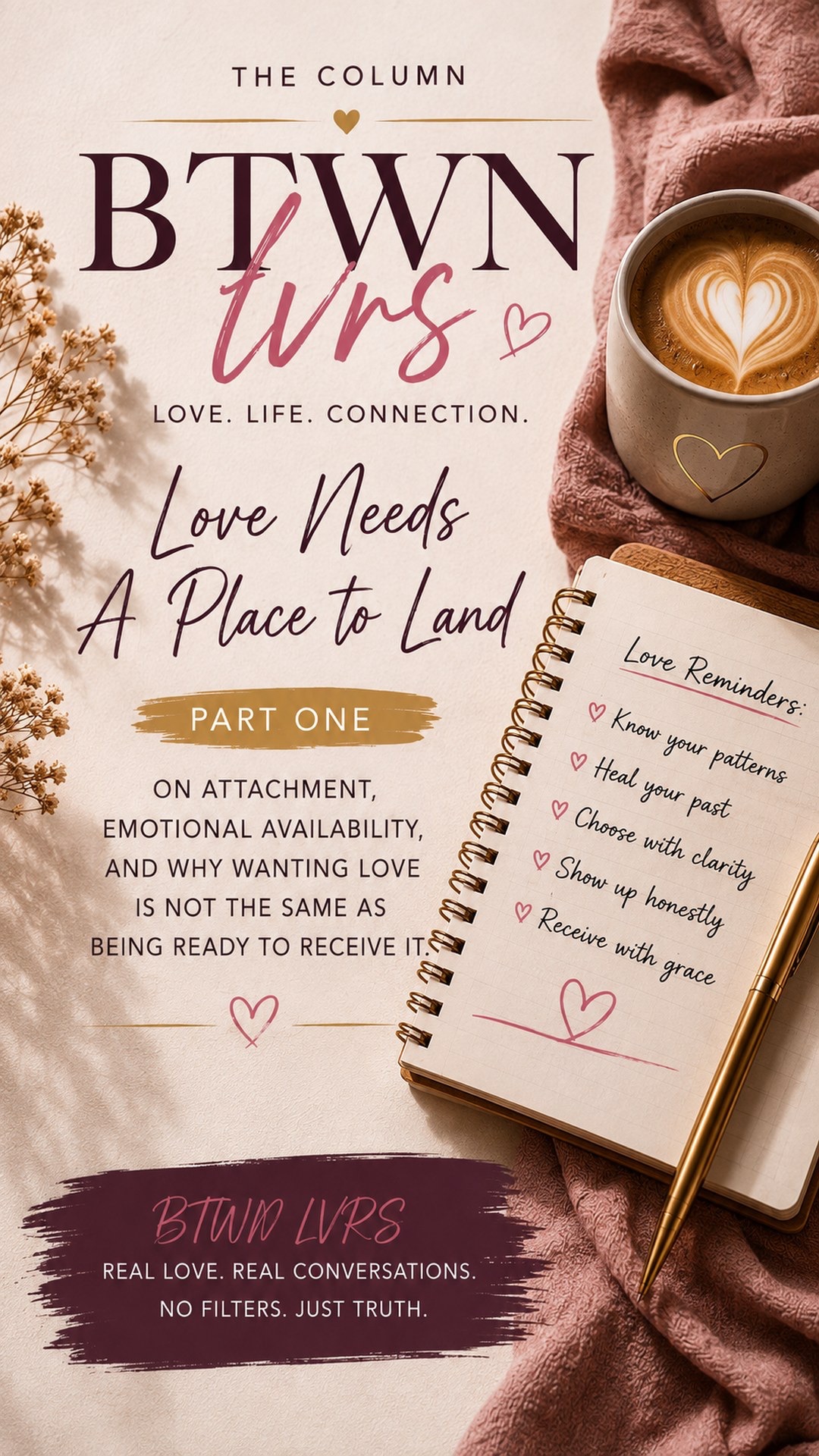
On attachment, emotional availability, and why wanting love is not the same as being ready to receive it.
Some people want love deeply, but do not know how to stay present when love arrives.
That sentence may feel unfair at first, because most people think wanting love and being available for love are the same thing.
They are not.
Wanting love is the desire.
Emotional availability is the capacity.
Attachment is often the story underneath both.
It is the way your nervous system learned to reach, retreat, cling, protect, soften, brace, trust, doubt, chase, avoid, explain, disappear, or hold on for dear life when closeness enters the room.
And closeness does enter the room.
Sometimes beautifully.
Sometimes loudly.
Sometimes wearing good cologne and saying all the right things.
Sometimes quietly, through consistency, gentleness, honesty, accountability, and the terrifying experience of being loved without having to perform for it.
That last one can be surprisingly uncomfortable.
Because when your heart has been trained by absence, inconsistency, rejection, criticism, betrayal, or emotional confusion, healthy love may not feel exciting at first.
It may feel suspicious.
Too calm.
Too steady.
Too available.
Too unfamiliar.
And sometimes, the person who says they want love finds themselves testing the very thing they asked for.
Not because they are bad.
Not because they are broken.
But because a part of them learned that love is not safe until it has been proven through chaos.
Attachment Is Not the Enemy
Attachment is not the enemy.
It is information.
It tells a story about how we learned to survive connection.
Some people learned to reach quickly because love felt uncertain. They may become anxious when someone pulls away, takes too long to respond, changes tone, needs space, or seems less engaged.
Their nervous system starts filling in blanks.
They may overthink.
Over-explain.
Ask for reassurance while apologizing for needing it.
Try to become easier to love.
Other people learned to create distance because love felt overwhelming, unsafe, demanding, or unreliable. They may want connection, but once it becomes too real, something in them starts looking for an exit.
They may shut down.
Change the subject.
Become busy.
Minimize feelings.
Keep options open.
Say they are “not good at emotions,” as though emotional availability is a rare family heirloom nobody remembered to pass down.
And then there are people who carry both.
They want closeness, but fear it.
They chase when they feel abandoned.
They retreat when they feel seen.
They crave love, but distrust the experience of needing it.
They want to be held, but the moment someone reaches for them, their body whispers, “Be careful.”
This is human.
Painfully human.
But human does not mean harmless.
Because unexamined attachment can turn love into a stage where old fears keep auditioning for new roles.
Emotional Availability Is a Practice
Emotional availability is not just saying, “I’m here.”
It is being able to remain present when someone else has feelings you cannot control.
It is listening without immediately defending.
It is being honest without becoming cruel.
It is allowing needs to exist without treating them as accusations.
It is making space for hard conversations without disappearing, punishing, mocking, minimizing, or turning every vulnerable moment into a debate tournament.
It is also being available to yourself.
That part matters.
Because if you cannot sit with your own fear, disappointment, shame, longing, tenderness, anger, grief, desire, or insecurity, it becomes very difficult to sit with someone else’s.
A person can be charming and emotionally unavailable.
Attractive and emotionally unavailable.
Successful and emotionally unavailable.
Spiritual and emotionally unavailable.
Funny and emotionally unavailable.
Generous and emotionally unavailable.
They may buy gifts, send texts, make plans, show up physically, and still struggle to be present emotionally.
And sometimes people confuse access with availability.
Just because someone is around does not mean they are available.
Just because someone answers does not mean they are emotionally present.
Just because someone loves you does not mean they know how to meet you.
That is where discernment becomes necessary.
Not judgment.
Discernment.
Because a good person can still be unavailable.
A loving person can still be limited.
A wounded person can still wound.
And a person can sincerely want connection while lacking the tools, willingness, or courage to participate in it well.
Wanting Love Is Not the Same as Being Ready
This is the part many are not ready to hear.
Wanting love does not automatically mean being ready to receive love.
Sometimes people want the idea of love.
The affection.
The companionship.
The good morning texts.
The shared meals.
The warm body beside us.
The proof that we are wanted.
But when love begins asking us to be honest, consistent, emotionally present, accountable, vulnerable, and mature, we may discover that we wanted the comfort of love more than the responsibility of it.
Love will ask things of us.
Not in a cruel way.
In a refining way.
It will ask:
Can you tell the truth sooner?
Can you communicate before resentment becomes your preferred language?
Can you receive care without looking for the trap?
Can you stop calling emotional unavailability “independence”?
Can you stop calling emotional intensity “passion”?
Can you let someone love you without making them constantly prove they will not leave?
Can you give someone space without making them earn their way back into your warmth?
That is not easy work.
But it is necessary work.
Because the goal is not simply to be chosen.
The goal is to become relational enough to love and be loved well.
With love, clarity, and a little nervous system honesty,
Tee
Your Love Guide
Leave a Reply